


⚡ TL;DR: This guide outlines common errors during mold remediation in Troy to help homeowners effectively eliminate infestations, prevent moisture issues, and protect their indoor air quality through professional help.
📋 What You’ll Learn
Dealing with mold in your Troy home requires more than just a quick wipe down. This guide helps you navigate common pitfalls to ensure your property remains safe and mold free.
- Identify ineffective cleaning methods that often make mold problems worse by ignoring deep roots, which allows colonies to regrow rapidly within your walls and drywall surfaces after cleaning.
- Detect hidden moisture sources typical to Troy basements, such as seasonal humidity changes and drainage issues, to stop mold from returning once professional remediation is finally complete at home.
- Avoid dangerous spore contamination during your cleanup efforts by using proper containment strategies that keep hazardous mold particles from spreading to other unaffected rooms in your residential property.
- Understand professional remediation benefits by comparing the long term costs of expert removal versus amateur quick fixes, ensuring you get the most value for your home maintenance budget.
📖 Reading time: 7 min
✍️ Author expertise: Troy certified water damage restoration specialist with decades of local mold remediation experience.
You find a small patch of fuzzy growth behind your drywall and assume a quick spray of bleach will solve the problem. That single decision might be the reason your family starts waking up with persistent coughs and headaches next month.
Mold in Troy is more than just an ugly stain on your basement wall. It is a living, breathing colony that knows how to outsmart your best DIY intentions, often spreading deeper into your structure while you think you have it under control.
Most homeowners lose thousands of dollars because they take action before they understand the biology of the threat. Before you grab a scrub brush or start tearing out materials, check these seven critical mistakes that often turn a minor issue into a full-scale property nightmare.

The Bleach Fallacy: Why Common Household Cleaners Fail to Eliminate Mold Roots
Most homeowners in Troy make the fatal mistake of reaching for the bleach bottle the second they spot a patch of mold. They assume that since bleach kills germs on a kitchen counter, it must annihilate mold on a porous basement wall. This is dead wrong.
Bleach is a water based solution that remains on the surface of porous materials like drywall, wood, and insulation. Because mold has deep, complex root structures called hyphae, the bleach only kills the surface color while the water component sinks deeper into the material.
You are essentially feeding the beast. You provide the moisture it craves while leaving the active roots to thrive in the dark.
Why Bleach Fails the Test
If you rely on bleach to clear your home of mold, you will likely face these three frustrating results:
- The mold appears to vanish for a few days, only to return with even greater aggression.
- The high pH level of bleach prevents it from penetrating porous surfaces, leaving the internal root system entirely untouched.
- You end up causing toxic chemical reactions or damaging the structural integrity of your building materials.
Stop playing chemist with household supplies that were never designed for industrial fungal removal. Professional remediation requires specialized antimicrobial agents that penetrate deep into the substrate to neutralize the roots once and for all. If you want the mold gone for good, you need to stop scrubbing the surface and start addressing the structural core.
Hidden Moisture Sources: Identifying the Troy-Specific Environmental Factors Fueling Growth
Many homeowners in Troy assume mold is just a sign of a leaky pipe, but our local climate often plays a bigger role than a faulty faucet. Michigan's freeze-thaw cycles combined with high humidity levels create a perfect storm for your home structure. If you ignore the source of the moisture, the mold will simply grow back within weeks, no matter how hard you scrub the surface.
You need to look beyond the obvious spots and investigate how Troy-specific factors interact with your home's unique layout. Neglecting these hidden culprits is essentially handing mold a map to your drywall:
- Basement Foundation Seepage: High water tables in Oakland County often push moisture through porous concrete walls during the spring thaw.
- Improper Sump Pump Drainage: If your pump discharges too close to the house, that water cycles right back into your foundation.
- High Indoor Humidity: In our area, improper ventilation in bathrooms or kitchens during cold months leads to condensation, which is a gold mine for fungal growth.
- Crawl Space Vents: Blocking these vents or leaving them open during humid summer months traps moisture in areas that lack airflow.
Think of mold as the symptom and moisture as the disease. If you treat the symptom while the root cause continues to pump water into your walls, you are just throwing your money away. You must audit your property for chronic dampness before you even think about remediation, or you will find yourself dealing with the exact same fuzzy patch by next season.

Dangerous DIY: Risks of Spreading Spores Through Improper Containment
The biggest mistake homeowners make is assuming that mold stays exactly where they see it. When you start scrubbing or cutting into contaminated drywall without professional containment, you are essentially launching a biological attack on your own home.
Mold spores are microscopic. They travel through the air with the slightest draft, and your home’s HVAC system acts like a superhighway for these irritants. Once you disturb a colony, you release millions of spores into the air, which can settle in your carpets, your bedding, and even your ventilation ducts.
Before you decide to handle this yourself, consider what happens when you disturb an active mold site:
- You turn a contained, localized issue into a whole-house contamination event.
- Regular household vacuums will suck up spores and then blast them right back out through the exhaust.
- Inadequate protective gear puts your health at risk, leading to respiratory distress.
- Tearing out materials without sealing the room forces spores into the crawlspace or attic.
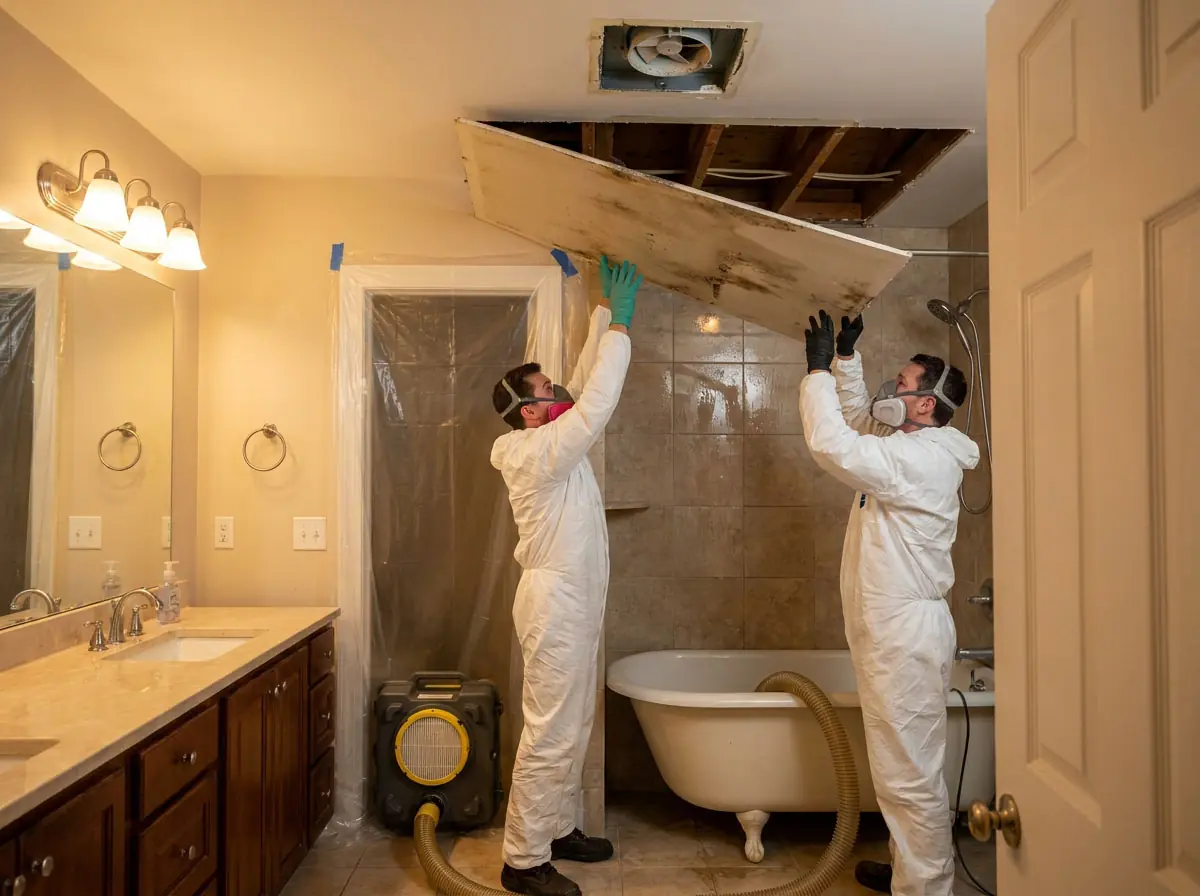
Proper remediation requires negative air pressure and airtight barriers to stop the spread. Professionals use specialized HEPA-filtered air scrubbers to trap spores before they travel into your living space. When you go the DIY route, you lack the heavy-duty equipment to catch these microscopic invaders. Instead of removing the problem, you often end up spreading the infestation to areas of the house that were previously healthy.
Professional Remediation vs. Quick Fixes: A Cost Comparison Table
Most homeowners assume that grabbing store bought chemicals is a savvy way to save cash. In reality, you are often just hitting the "pause" button while the mold roots dig deeper into your building materials.
Professional remediation involves precision equipment and containment that DIY methods simply cannot replicate. Here is how the costs break down over the life of your property.
| Factor | DIY Quick Fix | Professional Remediation |
|---|---|---|
| Initial Cost | Low (Supplies) | High (Labor/Expertise) |
| Long Term Risk | High (Recurring Mold) | Low (Guaranteed Results) |
| Property Value | Decreased (Hidden Damage) | Maintained (Verified Safety) |
| Health Costs | Variable (Medical Bills) | None (Controlled Environment) |
When you attempt a quick fix, you pay for scrubbing supplies, respirators, and eventual structural repairs once the mold inevitably returns. You are essentially paying for the same job twice because the first attempt failed to address the moisture source.
Professional services in Troy provide a one time investment that stops the cycle. We handle the heavy lifting, the disposal of contaminated materials, and the structural drying that prevents future growth. Consider these hidden costs of the DIY route:
- Cost of repeated cleaning supplies that never kill the roots.
- Depreciation of your home due to unresolved damage.
- Potential medical costs from toxic spore exposure.
- The price of your own time spent fighting a losing battle.

Lessons from a Troy Basement: A Real-World Case Study in Mold Recovery
Consider the story of a homeowner in a classic Troy colonial who discovered a musty smell coming from their basement storage area. Thinking it was just damp air, they wiped down the visible spots with vinegar and set up a box fan.
Within three weeks, the mold didn't just return; it migrated. By ignoring the moisture source—a slow, pinhole leak in a copper pipe behind the finished wall—the spores traveled through the HVAC system and settled into the living room carpet.
Here is what the homeowner learned when professional remediation finally became the only option:
- Simple surface cleaning does not stop moisture from feeding the colony behind the walls.
- Fans used without proper containment act like a distribution center for toxic spores.
- The cost of waiting is always higher than the cost of immediate, professional action.
This case serves as a harsh reminder that mold is a structural infiltrator. When you treat the symptom rather than the source, you are essentially paying for a temporary illusion of cleanliness while the building materials continue to decay.
Essential Prevention Strategies for Maintaining Long-Term Indoor Air Quality
Stopping mold before it takes root is infinitely cheaper than paying for professional remediation. In a place like Troy, where humidity fluctuates wildly throughout the seasons, your home needs active management to stay dry.
You must treat your indoor environment as a delicate ecosystem. If you ignore the basics, you are essentially inviting mold to move in permanently.
Proactive Steps for a Mold-Free Home
- Keep your indoor humidity levels strictly between 30% and 50%. A simple hygrometer from any local hardware store will help you monitor this daily.
- Ensure your bathroom fans run for at least twenty minutes after every shower. If your current fans are weak, replace them with high-capacity models that actually move air outside.
- Check your basement gutters and downspouts every spring. Water that pools against your foundation will eventually find a way through your concrete walls.
- Use a dehumidifier in your basement during the humid Michigan summer months. This single machine is the best insurance policy against widespread fungal growth.
Do not wait for a musty smell to tell you there is a problem. Inspect your crawl spaces and attic vents at least twice a year to ensure insulation is not blocking critical airflow.
If you see condensation on your windows during the winter, take it as a warning sign of poor ventilation. Clear the moisture immediately and consider adjusting your HVAC settings to keep the air moving freely throughout your property.
When to Call in the Experts for Safe Mold Removal
You might feel tempted to handle a small patch yourself, but mold is a deceptive opponent. If you see visible growth, there is a high probability that a larger colony is thriving behind your walls, beneath the floorboards, or inside your HVAC system.
Professional Mold Remediation is not just about wiping surfaces clean. It is about identifying the source of moisture and stopping the cycle before it destroys your property value.
You should stop your DIY efforts and pick up the phone if you notice these warning signs:
- The mold covers an area larger than 10 square feet.
- You detect a persistent musty or damp odor despite your best cleaning efforts.
- The mold returns shortly after you have cleaned the affected area.
- Family members begin to experience unexplained respiratory issues, eye irritation, or skin rashes.
- The growth is located inside your ventilation or heating ducts.
Do not gamble with the structural integrity of your Troy home or the health of your loved ones. We use specialized equipment like HEPA vacuums, industrial dehumidifiers, and moisture meters to verify that the mold is truly gone.
Attempting to fix this on your own often releases millions of microscopic spores into the air, which then settle in new locations to start the growth process all over again. Leave the containment and the complex cleanup to the professionals who have the gear and the experience to get it right the first time.
People Also Ask
Is it safe to clean mold by myself in a Troy home?
Small patches can sometimes be managed, but improper handling often releases dangerous spores into your HVAC system. Professionals use specialized equipment to ensure containment and complete removal without cross contaminating your living space.Why does mold keep coming back in my basement?
Recurrent mold growth indicates an unresolved moisture issue such as foundation leaks or high indoor humidity levels. You must address the underlying water source through professional moisture mapping to stop the cycle of regrowth.What are the health risks of exposure to indoor mold?
Mold exposure can trigger allergic reactions, asthma attacks, and respiratory distress in sensitive individuals. According to the EPA guidelines, prolonged exposure to high concentrations of mold may lead to chronic health issues if not addressed promptly.Does homeowners insurance cover mold remediation in Troy?
Insurance coverage for mold depends entirely on whether the growth resulted from a sudden, covered peril like a burst pipe. Policies typically exclude mold caused by long term neglect or gradual seepage, so it is vital to document the initial water damage event.How can I identify hidden mold behind my walls?
Hidden mold often presents as a persistent musty odor or unexplained health symptoms in family members. Expert technicians use infrared cameras and moisture meters to detect trapped water and fungal growth inside walls without causing unnecessary property damage.Need Water Damage Restoration Services?
We provide rapid water damage restoration and structural drying services to restore your property in Troy and surrounding communities (48083, 48084, 48098, 48310). Our team arrives quickly to mitigate damage and return your home or business to a safe, dry condition.
Request Custom Quote