


⚡ TL;DR: Tallahassee residents can effectively manage mold remediation by understanding local humidity challenges, recognizing hidden infestations, and prioritizing professional containment techniques to protect their homes from long term damage.
📋 What You’ll Learn
Living in Tallahassee means battling high humidity levels that turn minor leaks into serious mold infestations. This guide reveals the proven strategies smart locals use to protect their homes from damage.
- Understand our unique climate impact on your home by learning why the high humidity levels found throughout the Big Bend region require specialized mold prevention tactics that differ elsewhere.
- Detect hidden mold before it spreads by recognizing the early warning signs behind your baseboards and inside wall cavities that often go unnoticed until structural damage becomes very expensive.
- Compare remediation costs versus risks using our detailed breakdown to decide when you should hire a professional versus attempting a minor cleanup yourself to ensure your indoor air safety.
- Master professional containment protocols by seeing how experts isolate affected areas to prevent dangerous spores from migrating through your ventilation system and contaminating other rooms in your house.
- Implement long-term moisture control with simple strategies tailored for Florida living that keep your property dry, prevent future outbreaks, and save you thousands of dollars in restoration costs.
📖 Reading time: 7 min
✍️ Author expertise: Tallahassee restoration expert with fifteen years of experience mitigating water damage and mold issues.
You wake up, walk into your guest bedroom, and hit a wall of thick, musty air that hits your lungs like a damp wool blanket. That faint, earthy smell isn't just an annoyance; it is a neon sign screaming that your Tallahassee home is currently hosting an unwanted, toxic colony of mold.
Most folks here make the mistake of scrubbing the surface or popping open a window, thinking they can outsmart the Florida humidity. They are wrong, and they are putting their family health at risk while the problem festers right behind the drywall.
Smart Tallahassee homeowners take a different route because they know that mold is a symptom, not the root cause. Here is how you can actually stop the growth for good instead of just putting a band-aid on a growing health hazard.
The Tallahassee Climate Trap: Why Our Humidity Makes Mold Aggressive
Living in Tallahassee means enjoying lush greenery and beautiful oak trees, but it also places your home in a constant war against moisture. Our local climate acts like a giant greenhouse, keeping humidity levels high enough to turn any minor leak into a full-scale biological disaster.
When the air stays heavy with moisture, your building materials become a sponge. Drywall, wood framing, and insulation soak up that dampness, creating the perfect buffet for mold spores looking for a place to settle and multiply.
Here is why our specific environment makes mold so aggressive:
- Consistent High Dew Points: Even when it does not rain, the air holds massive amounts of water that your AC system struggles to pull out.
- Rapid Spore Reproduction: Warmth combined with trapped humidity allows colonies to double in size in as little as 24 to 48 hours.
- Hidden Condensation: Our temperature swings create internal sweating inside walls, fueling growth where you cannot see it.
If you think a basic dehumidifier is enough to stop this, you are likely losing the battle. Mold in North Florida does not just sit on the surface; it burrows into porous materials, feeding on the cellulose found in your home's structural components.
Identifying the Hidden Culprits Behind Your Baseboards
Most Tallahassee homeowners only notice mold when it develops a visible, fuzzy patch on their living room wall. By that point, you are likely looking at the tip of the iceberg, because mold thrives in the dark, damp voids where your home breathes.
The space behind your baseboards acts as a perfect transit system for moisture. Leaky windows, condensation from poorly insulated exterior walls, or minor plumbing drips eventually pool at the bottom of your drywall.
Common Hotspots You Might Be Missing
If you suspect a problem, stop looking at the surface and start investigating the structural seams of your home. You should be checking these specific areas for the first signs of decay:
- The bottom edge of drywall where it meets the floor plate.
- Corners of rooms that share an exterior wall facing the north side.
- Areas behind furniture that sit flush against cold, damp walls.
- Spaces near bathroom vanity kickplates where water frequently splashes.
You can identify these hidden colonies by looking for subtle warning signs before the smell becomes unbearable. Watch for paint that looks like it is starting to bubble or peel away from the wall without an obvious cause. If the baseboard feels soft to the touch or if you see a thin, dark line forming where the wood meets the floor, you have likely found a thriving colony. Do not wait for it to grow, as these spores are already circulating through your air supply every time your HVAC system kicks on.

Remediation Costs vs. DIY Risks: A Hard Look at the Numbers
Most Tallahassee homeowners try to save a few bucks by grabbing a bottle of bleach and a scrub brush. That is a dangerous gamble. While store-bought chemicals might clear the surface, they often fail to kill the mold roots deep inside your porous materials. You aren't just wasting time; you are potentially aerosolizing dangerous spores throughout your entire air conditioning system.
| Factor | DIY Approach | Professional Remediation |
|---|---|---|
| Initial Cost | Low (Cleaning supplies) | High (Equipment & Labor) |
| Health Risk | High (Exposure to spores) | Low (Certified safety gear) |
| Effectiveness | Surface only | Full root removal |
| Liability | Property damage risk | Licensed and insured |
| Long-term Cost | Extreme (Recurring growth) | Minimal (Solved once) |
Think about the hidden costs of an incomplete DIY job. If you miss a single patch behind the drywall, the colony will return with a vengeance within weeks. You will be stuck paying for secondary mold damage, professional cleanup, and potentially hefty medical bills for respiratory issues caused by breathing in those runaway spores.
Why Precision Matters
Professional remediation is not just about cleaning; it is about containment and clearance. We use industrial-grade HEPA vacuums and specialized air scrubbers to trap spores before they travel. When you hire a pro, you are paying for the guarantee that the environment is actually safe to breathe again.
- DIY methods lack the heavy-duty dehumidification required for our Florida climate.
- Professional crews identify the source of moisture that caused the outbreak initially.
- A job done right protects your home value and keeps your insurance coverage intact.
Professional Containment Protocols: How We Stop Spores from Spreading
Most DIY mold removal attempts fail because they turn your living room into a spore-launching factory. The moment you start scrubbing a patch of mold, you vibrate the colony and send thousands of microscopic seeds into your home's air supply. Once those spores take flight, they settle in your HVAC system, your bedding, and your curtains, creating new colonies in places you cannot even see.
Professional remediation is not about cleaning; it is about containment. Before we touch a single square inch of mold, we lock down the zone to ensure the rest of your house remains a clean air sanctuary. We use industrial-grade measures that prevent the problem from moving from one room to another.
The Barrier Strategy
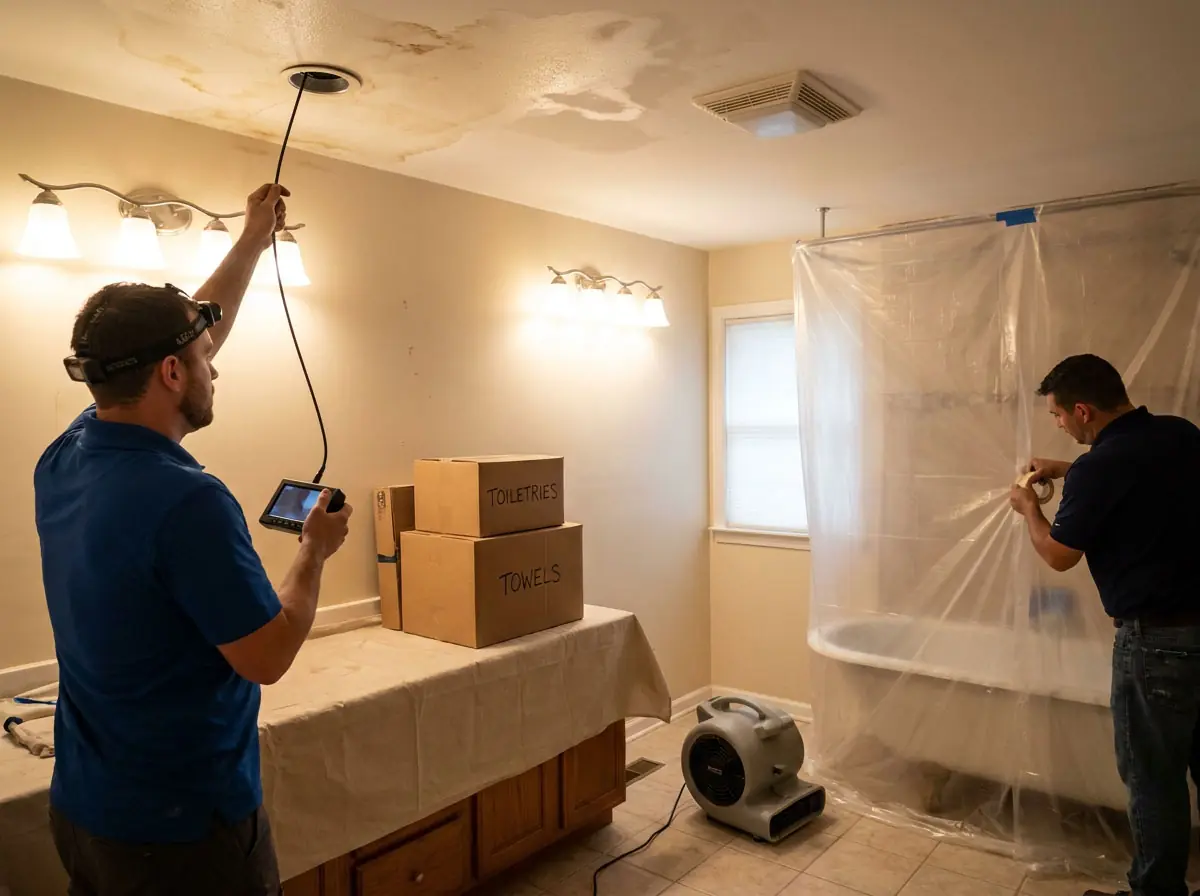
We seal off the affected areas using heavy-duty poly sheeting and negative air machines. These machines act like a vacuum for your room, keeping the air pressure lower than the rest of the house. Because the air pressure inside the containment zone is lower, air flows into the room rather than out. This guarantees that any dislodged spores stay trapped until our HEPA-filtered scrubbers capture them.
- Negative Air Pressure: Ensures airflow moves inward, locking spores inside the work zone.
- Critical Barriers: We seal all HVAC vents and doorways to stop cross-contamination.
- Decontamination Chambers: Our techs pass through specialized airlocks to strip off contaminated suits before entering clean areas of your home.
- HEPA Filtration: We scrub the air to remove particles as small as 0.3 microns, which is much smaller than the average mold spore.
When you handle this yourself, you are essentially dusting your home with toxic mold. By trusting a professional, you are preventing an expensive nightmare of cross-contamination that could ruin your carpets and furniture. We treat your Tallahassee home like a surgery suite, keeping the contamination localized so you can breathe easy during the process.

Rescuing a Historic Midtown Bungalow from Black Mold
We recently took on a project in a charming Midtown bungalow that looked perfect from the curb. The owner felt a persistent cough and noticed dark, fuzzy spots blooming along the baseboards in the primary bedroom.
What looked like a minor aesthetic issue was actually a massive infestation thriving in the wall cavity. Decades of Florida moisture had turned the paper backing of the drywall into a high-protein buffet for Stachybotrys, the nasty stuff often called black mold.
Here is what we discovered during our initial inspection of the structure:
- Hidden saturation: Moisture had wicked up from a compromised crawl space seal.
- Airborne threats: Mold spores were traveling through the HVAC ducts into every room.
- Structural decay: The wooden studs behind the wall were soft and compromised.
We treated this home like a surgical site rather than a construction project. We sealed off the bedroom with heavy-duty poly sheeting to ensure that not a single spore escaped into the rest of the house during the demo phase.
Our team used negative air machines to create a vacuum effect, forcing air to flow into the containment area rather than out. By the time we removed the contaminated materials, the indoor air quality was cleaner than the air outside on a humid Tallahassee afternoon.
After the physical removal, we applied a professional-grade antimicrobial sealant to the framing lumber. This ensures that even if moisture levels spike again in the future, the wood will not provide a food source for new growth.
Long-Term Moisture Control Strategies for Florida Living
Living in Tallahassee means fighting a constant war against moisture. If you want to keep your home mold-free, you have to think like a professional inspector and control the environment before the spores take root.
Most locals make the mistake of ignoring their crawl spaces or neglecting their HVAC maintenance. If your air conditioner is oversized for your home, it will cool the air too quickly without removing the humidity, leaving your walls cold and damp. That is a mold paradise.
To win this fight, focus on these essential habits that keep your property dry:
- Inspect your home exterior every few months to ensure gutters are free of debris.
- Install a digital hygrometer to monitor indoor humidity levels, keeping them strictly below 50 percent.
- Ensure your dryer vent exits the house entirely rather than dumping warm, wet air into the attic.
- Run exhaust fans in bathrooms for at least 20 minutes after every shower to clear the moisture.
Do not rely on cheap dehumidifiers that burn out in a month. Invest in high-capacity units for basements or damp closets, and make sure your HVAC system receives a professional checkup twice a year. Taking these steps stops the cycle of moisture that fuels toxic growth, giving you peace of mind that your home is safe for your family.
Final Words
Mold is not a weekend project you can conquer with a bucket of bleach and some optimism. It is a biological organism that thrives on the specific moisture levels we battle every day here in the panhandle.
If you suspect an outbreak, you need to act with surgical precision rather than panic. Ignoring that musty scent is the fastest way to turn a minor patch of growth into a full scale structural nightmare that ruins your property value.
When you are ready to stop guessing and start fixing, our team provides the professional Mold Remediation you actually need. We do not just wipe away the visible grime; we kill the spores and hunt down the moisture source that invited them in the first place.
Remember these golden rules for a healthy Florida home:
- Keep your indoor humidity levels strictly below 50 percent.
- Never paint over mold because it just feeds the colony.
- Address plumbing leaks within twenty four hours to prevent spores from taking hold.
- Trust your nose; if it smells damp, there is a hidden problem lurking behind your walls.
You have worked hard for your home and your health. Do not let a colony of fungi steal your peace of mind or put your family at risk.
People Also Ask
Is mold remediation covered by homeowners insurance in Tallahassee?
Coverage typically depends on the underlying cause of the moisture intrusion. While sudden water damage like a burst pipe is often covered, long term issues resulting from neglect are usually excluded from your policy.How can I tell if I have a serious mold problem in my home?
Look for visible fungal growth, persistent musty odors, or signs of water staining on drywall and ceilings. If you experience unexplained respiratory issues, it is important to consult the EPA guidelines regarding indoor air quality and mold exposure.Why is DIY mold removal often ineffective for Florida homes?
Surface cleaning often fails to address the root moisture source or the microscopic spores embedded deep within porous materials like wood and insulation. Professional remediation ensures that hidden colonies are neutralized to prevent them from recurring during our humid seasons.What is the typical timeline for professional mold remediation?
Small projects can be completed in a few days, but extensive infestations in larger or older structures may take a week or more. The process involves containment, professional HEPA air scrubbing, and structural drying to ensure the home is completely safe for occupants.Are certain types of homes in Tallahassee more prone to mold?
Historic homes with pier and beam foundations or older HVAC systems often face higher risks due to poor ventilation and ground moisture. Smart local homeowners prioritize regular crawl space inspections and dehumidification systems to mitigate these structural vulnerabilities.Need Water Damage Restoration Services?
We provide rapid water damage restoration to restore your property and prevent further structural issues throughout Tallahassee and surrounding areas (32301, 32303, 32308, 32311, 32312). Our team delivers immediate mitigation to secure your home or business and complete the drying process quickly.
Request Price Estimate