


⚡ TL;DR: Professional water damage restoration in Portland requires specialized equipment and quick action to prevent hidden structural decay and mold growth, so learn how to protect your unique home.
📋 What You’ll Learn
Discover the reality of moisture control in the Pacific Northwest as we reveal the hidden, professional strategies required to protect your Portland home from long-term structural water damage and decay.
- Understand why natural drying fails because Portland’s high ambient humidity levels prevent standard evaporation, trapping moisture inside your walls and causing hidden structural rot to develop rapidly.
- Detect hidden moisture migration patterns through Oregon framing materials, which often wick water into floor joists and behind cabinets, leading to unseen damage that homeowners frequently overlook initially.
- Identify critical mold growth windows by learning the exact timeline required for fungal colonies to sprout, allowing you to prioritize the most urgent areas after a leak occurs.
- Master insurance claim negotiation tactics to ensure your restoration estimate is accurate, transparent, and covers the necessary professional equipment needed to fully dry out your historic property.
📖 Reading time: 8 min
✍️ Author expertise: Portland restoration contractor with a decade of field experience mitigating local water disasters.
You wake up to the rhythmic drip of a ceiling leak, or worse, you step into a squishy carpet that wasn't there when you went to bed. In Portland, the constant rain is only half the battle; the real enemy is the silent rot that moves in the moment your walls get wet.
Most homeowners assume a quick mop-up and a fan will save the day. They are dead wrong, and that simple mistake often costs them thousands in hidden structural repairs later on.
There are specific traps, shortcuts, and industry secrets that restoration crews usually keep to themselves while the clock ticks on your home's integrity. If you want to stop the damage before it ruins your floors and your bank account, pay close attention to the reality of the situation below.

The Portland Humidity Trap: Why Air Drying Never Works
Portland is famous for its damp, gray climate. Because our ambient humidity often hovers near saturation levels, your home acts like a giant sponge that never gets a chance to wring itself out.
When you set up a standard household fan, you aren't removing moisture. You are simply circulating stagnant, water-heavy air across a surface that cannot absorb any more liquid.
This is a fool’s errand. Instead of drying your home, you are effectively creating a tropical greenhouse inside your wall cavities.
The Science of Static Air
Restoration pros know that evaporation requires a pressure differential. If the air in your room is already heavy with moisture, the water trapped inside your drywall has nowhere to go.
Without industrial-grade dehumidification, the moisture stays locked in the building materials. It eventually migrates deeper into the structure, fueling a slow-motion disaster.
- Household fans move air but do not extract water.
- High humidity levels in Oregon prevent natural evaporation.
- Trapped water inside walls leads to accelerated rot within days.
By the time you see the dark spots on your baseboards, the wood studs behind them are likely already turning soft. You aren't just dealing with a wet carpet; you are fighting a battle against the local climate that your living room fan is destined to lose.
Hidden Wick Effects: How Moisture Travels Through Oregon Framing
Most Portland homes rely on softwood framing like Douglas Fir, a material that acts like a straw for standing water. When your floor gets wet, the moisture does not just sit there; it climbs vertically through the wood grain, a process we call wicking.
This hidden migration allows water to travel several feet above the actual spill site. You might wipe up the surface, but the studs inside your walls are busy drinking up that water, trapped behind your drywall and baseboards.
Consider these dangerous pathways for hidden water travel:
- The sill plate, which anchors your home to the concrete foundation, acts as a primary sponge.
- Wall cavities become chimneys for humidity, pulling moisture upward into subflooring.
- Insulation blankets absorb and hold water against studs for weeks, creating a perfect incubation chamber.
Because our Oregon climate already keeps the air saturated, these structural components rarely dry out on their own. Instead, the trapped water causes the wood to swell, distort, and eventually harbor toxic microbial growth that stays invisible until the paint starts bubbling or a foul odor takes over your living room.

Essential Drying Equipment Checklist: A Comparison Table for Homeowners
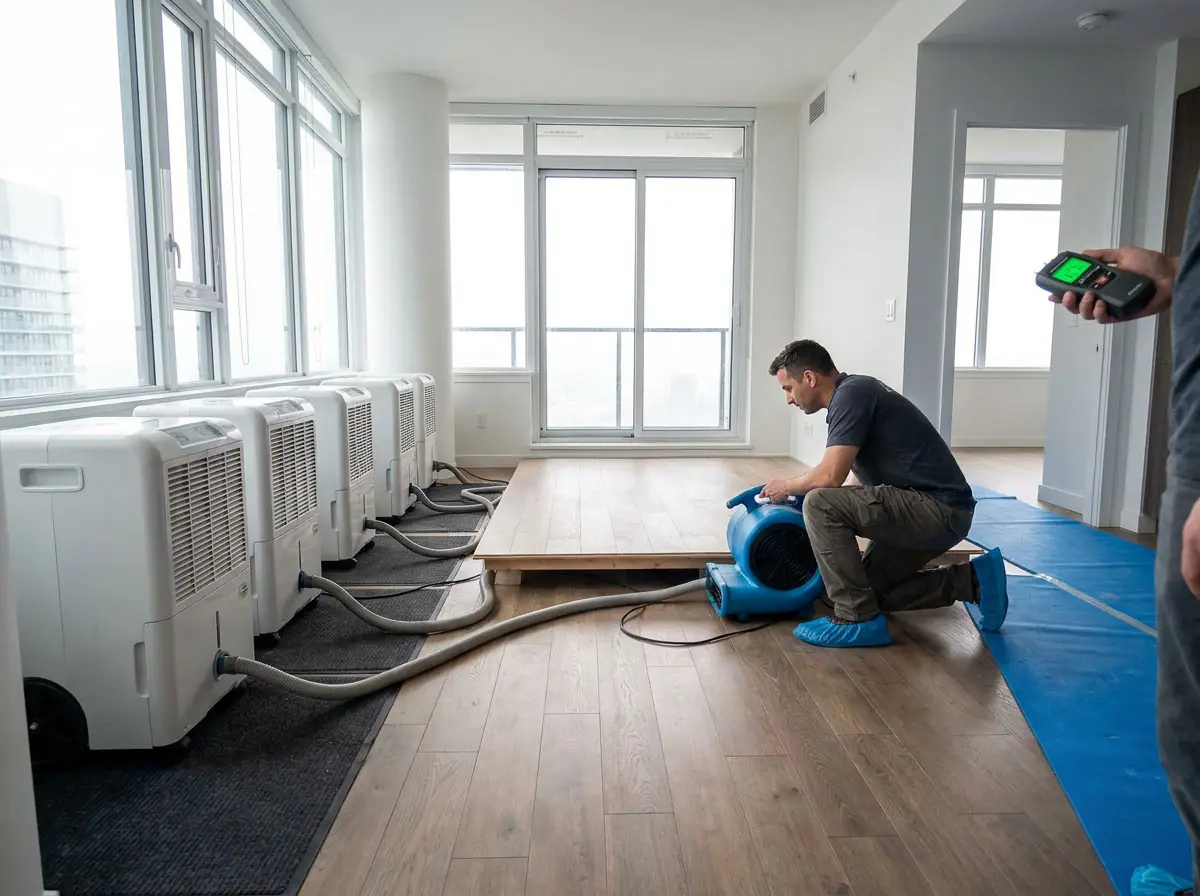
Hardware store fans and standard dehumidifiers are essentially toys when you are dealing with a saturated Portland home. They move air around, but they do not solve the evaporation deficit caused by our damp climate. Professional restoration relies on industrial gear that targets the actual moisture content inside your drywall and floor joists.
| Equipment Type | Purpose | DIY vs Pro |
|---|---|---|
| LGR Dehumidifier | Removes deep humidity | Pro only |
| Air Mover | High velocity airflow | DIY possible |
| Moisture Meter | Detects hidden water | Pro essential |
| HEPA Air Scrubber | Traps mold spores | Pro essential |
If you choose to rent equipment, you need to understand that placement is everything. Simply pointing a fan at a wet spot often drives moisture deeper into the studs, which creates a prime environment for mold colonies to bloom in the dark.
Here is what you actually need to ensure your home dries out completely:
- Low Grain Refrigerant (LGR) Dehumidifiers: These pull moisture from the air much faster than standard units.
- Industrial Air Movers: You need high velocity air that skims the surface to force evaporation.
- Pinless Moisture Meters: Without these, you are just guessing if the wood is dry.
- HEPA Filtration: Essential to catch the spores that launch into the air once the drying process triggers a mold reaction.
Most homeowners spend hundreds on rentals only to realize their walls are still damp behind the paint. If you cannot measure the moisture levels, you are not actually drying the structure. That is the professional difference that saves your home from total rot.
The Mold Migration Timeline: Critical Windows You Cannot Ignore
Most Portland homeowners view mold as a distant threat that grows over weeks, but in our damp climate, it is a lightning fast invader. Once moisture settles into your drywall or insulation, the biological clock starts ticking immediately.
You have a very tight window before spores transition from dormant particles into active, structural colonies. If you miss this mark, you aren't just looking at a cleanup job; you are facing a full scale remediation nightmare.
The Critical Window Breakdown
- 0 to 24 Hours: Water absorption is at its peak. Surface mold is not yet visible, but moisture levels have reached the saturation point required for rapid germination.
- 24 to 48 Hours: The invisible war begins. Spores begin to colonize on organic materials like paper backed drywall and wood framing.
- 48 to 72 Hours: Visible growth appears. This is the moment where air quality inside your home begins to degrade significantly, posing health risks to your family.
- Beyond 72 Hours: Full scale infestation. Mold is now deeply embedded in porous materials, and structural integrity may begin to suffer if the rot has taken hold.
Do not wait for the musty smell to hit your nose before you call for help. By the time you can actually scent the mold in the air, thousands of spores have already circulated through your HVAC system and landed in your lungs.
Speed is your only leverage. If your home has been compromised, every hour you spend debating whether to call a professional is an hour you are losing to the migration of toxic growth.

Case Study: Saving a Historic Portland Craftsman from Structural Decay
Last winter, we were called to a classic Craftsman in the Laurelhurst neighborhood. The owner thought a minor pipe burst behind a wall was no big deal, but the old-growth Douglas fir framing had turned into a sponge for the leaked water.
Because these homes feature balloon framing and antique lath and plaster, moisture doesn't just sit on the surface. It travels vertically through the wall cavities, soaking floor joists that have been drying for nearly a century.
By the time we arrived, the following issues were already compromised:
- The original white oak floors were cupping due to moisture trapped in the subfloor.
- Mold colonies were beginning to sprout on the underside of the wood lath.
- The sill plate, which connects the house to the foundation, was showing signs of soft rot.
We had to perform a controlled tear-out that preserved the original molding while getting deep into the wall cavities. We used low-grain refrigerant dehumidifiers to pull moisture out of the dense, old timber without causing the wood to crack from drying too quickly.
If we had used high-heat drying methods, those historic timbers would have warped or split instantly. Restoring a home like this is about finesse, not just brute force air movement. You have to respect the materials, or you will lose the soul of the house forever.
Strategic Negotiation: Working with Insurance Adjusters and Restoration Estimates
Insurance companies often employ adjusters whose main goal is to minimize the payout on your claim. They want the cheapest fix possible, which rarely aligns with the long term structural needs of a damp Portland home.
You need to be your own best advocate by documenting everything before a single piece of drywall is touched. Never let an adjuster tell you that a dehumidifier for twenty-four hours is enough when the moisture has already wicked into your floor joists.
Here is what you must have ready before the adjuster arrives at your door:
- Detailed photographs of all affected areas before any cleanup.
- A moisture mapping report that proves the extent of the water migration.
- An itemized list of damaged personal property with replacement costs.
- The official scope of work from a licensed restoration contractor.
Understand that your restoration contractor is your most powerful ally in this fight. A professional restoration company knows exactly how to speak the language of adjusters and uses industry standard software to create bulletproof estimates that are difficult for insurers to deny.
If the insurance offer feels low, do not sign the first settlement. You have the right to request a supplement or bring in a public adjuster if they continue to lowball the actual cost of repairs. Protect your home, hold your ground, and force them to account for the hidden damage that a quick glance will surely miss.
Final Words
When your home takes on water in a climate as damp as ours, speed is your only ally. Every hour you spend debating whether to call a pro is an hour the moisture content in your studs climbs toward the point of no return.
If you suspect water has migrated behind your baseboards or under your flooring, stop waiting for the materials to dry on their own. You need professional Water Damage Restoration tools to extract moisture from places that air circulation simply cannot touch.
Protecting Your Investment
You have worked hard to maintain your property, so do not let a preventable leak turn into a total loss. Remember that the aftermath of a flood is rarely just about wet carpet; it is about the long term health of your home and the safety of your family.
- Inspect your exterior flashing and gutters before the next storm hits.
- Keep a moisture meter on hand to identify hidden spikes in humidity.
- Document everything immediately if you plan to file a claim.
Trust your instincts when things smell musty or look warped. Dealing with water issues early is the only way to avoid the crushing costs of structural decay down the line.
People Also Ask
Does homeowners insurance cover water damage in Portland?
Most standard policies cover sudden and accidental water damage, such as a burst pipe. However, damage caused by neglected maintenance or flooding from outside sources typically requires a separate flood insurance policy.How fast does mold grow after water damage?
Mold can begin to colonize damp surfaces within 24 to 48 hours after exposure to moisture. This is why immediate professional mitigation is necessary to prevent spores from spreading throughout your home.Is it safe to stay in a house with water damage?
Staying in a home with significant water damage is often unsafe due to the risk of electrical hazards and poor indoor air quality. If you see signs of structural warping or persistent odors, you should relocate until a professional assessment confirms the property is safe.Why is Portland humidity a problem for drying homes?
High ambient humidity makes it difficult for traditional air drying methods to effectively pull moisture out of porous building materials. Without industrial dehumidification equipment, indoor surfaces remain damp, which leads to secondary damage and rot.Need Water Damage Restoration Services?
We provide rapid water damage restoration across Portland and surrounding areas to dry your property and restore your home. Our team arrives quickly to stop structural damage and mitigate long-term moisture issues (97201, 97204, 97205, 97209, 97210).
Request Price Estimate